
Getting Bigger Things Done: A Hands-on Workshop on How to Use AI in Projects
Projects rarely fail because of the idea itself. They fail in execution. Execution is precisely what AI is changing right now. If you set your project up correctly, you can deliver work of a complexity and speed that would have required a full team and far more time only a few years ago.
The seminar works in three stages. First, consider how to build a setup that carries your project from the initial sketch to the final result without the AI having to start from scratch each time. Team: What does a shared knowledge space look like when briefings, onboarding, and decisions are stored in a way that is accessible to both people and machines? The final stage is for external stakeholders and asks: how can I collaborate with clients, partners, and other outsiders within such a setup without creating trust or confidentiality issues?
We work on real projects that the participants bring, such as a start-up idea, a student initiative, a job or a commitment. After a brief introduction, we spend a full Saturday workshop building the first setups and tailoring the projects. This is followed by seven weeks of field testing, supported by three open studio sessions. On the second workshop Saturday, we present our results to each other, share what we have learnt and develop model setups for future AI projects.
If you have always suspected that AI enables you to achieve much more today, you are warmly invited to put that to the test here.
Dipl. Manuel Dolderer
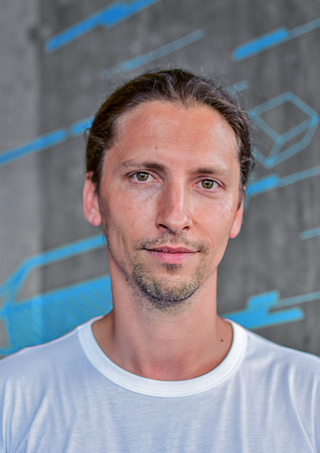
Manuel Dolderer setzt sich als Bildungsunternehmer, Gründer, Berater und Vordenker dafür ein, Hochschulbildung im Zeitalter von KI als Raum für Neugier, Selbstwirksamkeit und gesellschaftliche Verantwortung neu zu denken und systemisch zu verankern.
Er ist Mitgründer und war langjähriger Präsident der CODE University of Applied Sciences in Berlin, einer innovativen Hochschule für digitale Produktentwicklung. Dort verantwortete er den Aufbau und die Etablierung eines neugiergetriebenen, projektbasierten Lernmodells, das früh auch Fragen des Einsatzes von AI in Lehre und Praxis adressierte. Parallel gründete er die code+design Initiative, einen Verein, der mit seinen Angeboten chancenbenachteiligten Jugendlichen hilft, den praktischen Einsatz digitaler Technologien zu erlernen und dabei Selbstwirksamkeitserfahrungen zu machen
Davor verantwortete er den Aufbau der praxisHochschule (Klett-Gruppe), die später in die Europäische Fachhochschule (EU|FH) überging. Er studierte Wirtschaftswissenschaften, Philosophie und Kulturwissenschaften an der Universität Witten/Herdecke, wo er sich unter anderem als Vorstand der StudierendenGesellschaft engagierte.
Als Mitglied der Peer-to-Peer-Beratung des Hochschulforums Digitalisierung hat er zahlreiche Hochschulen bei der digitalen Transformation begleitet. Mit Vorträgen und Publikationen – unter anderem bei OEB Global, Times Higher Education, dem University Future Festival und TEDx – trägt er seit Jahren zu internationalen Diskussionen über die Zukunft der Hochschulbildung bei.
Derzeit engagiert er sich als Projektleiter Transformation an seiner Alma Mater, der Universität Witten/Herdecke, und wirkt zugleich an der Gründung der Zukunftsallianz für Transformative Bildung mit.
Participation modalities
If you would like to have the course credited as a specialist module within your main degree programme, please register additionally using the WiGe course number 400.0028.
Participation requires a firm commitment. This involves attending both seminar blocks in full, running a real project of your own using the setup you develop during the seminar and providing weekly documentation. Throughout the semester, you will also be expected to actively work with and experiment on a range of AI tools, refining and sharing your own setup as you go.
Students who are already running a start-up, leading a project or pursuing an initiative outside their studies are explicitly invited to participate.
Objectives & Competences
Topics:
The three stages of AI-supported project work are: solo, team and multi-stakeholder. Context engineering: using system prompts, project rules, briefings and persistent notes as the basis for any AI collaboration. Architecture of knowledge spaces that machines can read. Routines for recurring project work. Multi-stakeholder communication built on trust. The roles that AI can take on in a project range from assistant work to critical reviewing. Confidentiality, data protection and quality risks. Augmentation rather than automation as a design principle. The 'jagged frontier' of knowledge work (Dell'Acqua et al., 2025): the places where value and errors reliably emerge. Cognitive offloading and the question of what project responsibilities must never be handed over.
Learning outcomes (knowledge):
Students will understand how generative AI systems work to the extent required to use them productively and critically in a project. They can survey the tool landscape and select tools based on specific criteria. They are familiar with the key empirical findings on the impact of AI on knowledge work, teamwork, and project outcomes. They can distinguish between solo, team and stakeholder setups, identify their typical points of friction and recognise the design decisions that follow.
Competencies (practice):
Students will build a documented AI setup for their own project work and a simple shared setup for a team. They create briefings, decision logs and workflow documentation that can be used by both humans and machines. They then run a real project on this setup for seven weeks, making corrections as they go and providing and receiving constructive peer feedback. They assess risks such as breach of confidentiality, hallucination and misplaced trust, and mitigate them. The result is a prototype setup for future projects.